Zapier programmatic SEO: a teardown of its integration page links
A teardown of how Zapier links its 150,000 integration pages, what a smaller site can copy, and a hub-to-pair link plan you can build yourself.
 Maciej WiatrRead as markdown
Zapier is the example most people point to when they talk about programmatic SEO. Most write-ups stop at “they have a page for every integration.” This teardown of Zapier programmatic SEO follows the links instead. It goes from the app directory to category hubs, then to single-app pages, then to app pairs and zap templates. Then it splits what a smaller site can copy from what only Zapier has, and ends with a link plan you can build.
How does Zapier use programmatic SEO?
Zapier runs three templates under /apps/:
- Single-app pages at
/apps/{app}/integrations, aimed at “{app} integrations”. - App-pair pages at
/apps/{a}/integrations/{b}, aimed at “connect {a} and {b}”. - Zap template pages at
/apps/{a}/integrations/{b}/{id}/{slug}.
The pages are filled from Zapier’s own data: triggers, actions, templates, FAQs and related blog posts. Zapier’s own post on the topic calls the triggers and actions “a major part of the unique data” and says they are “completely unique to the Zapier website.”

Two newer details rarely appear in case studies.
- The AI-agent layer. Zapier’s robots.txt declares an
Agentmap, setsContent-Signal: ai-train=yes, search=yes, ai-input=yes, and explicitly allows GPTBot, ClaudeBot, PerplexityBot and Google-Extended. Its llms.txt calls/appsthe “canonical list of connectable apps.” Markdown versions of the app and pair pages are also served. - Crawl rules. The same robots.txt blocks
/*?,/apps/*/landing/,/apps/*/integrations/*/landing/and/apps/*/roles/*/. Sorted, filtered and landing-page variants never enter the crawl.
How many integration pages does Zapier have, and how much traffic do they get?
The App Directory says Zapier “connects 10412+ apps.” upGrowth counted the sitemaps in September 2026 and found 9,724 single-app pages and 140,272 pair pages, about 150,000 URLs before templates. The robots.txt lists separate “one-service” and “two-service” sitemap indexes. The two-service index has 59 child sitemaps and no <lastmod> in the index file. Some child lastmod dates go back to 2019.

Traffic is harder to pin down, because every figure is a third-party estimate:
| Source | Date | /apps/ share or figure |
|---|---|---|
| Ahrefs | Aug 2022 | 16% of organic traffic |
| Practical Programmatic | undated | Gmail integrations 60k, Google Sheets 34k |
| upGrowth (Semrush, US) | Sept 2026 | about 34,800 visits, about 2% |


upGrowth also reports that site keywords fell from about 673K in February 2026 to about 365K in September 2026. In the same data, Google Calendar + Notion dropped from 800 visits to about 8. MadX says figures like these “should be treated as directional.” I agree. The tools and dates differ, so the 16% and 2% figures can’t be compared directly. What you can say is that most current write-ups still repeat the 2022 numbers as if nothing had changed.

How are Zapier’s app pages and app-to-app pages linked to each other?
flowchart TD
  A[App directory] --> B[15 category hubs]
  B --> C[Subcategory pages]
  B --> D[Single app pages]
  C --> D
  D --> E[App pair pages]
  E --> D
  E --> F[Zap template pages]
  F --> D
  E --> B
The directory. /apps links to 15 categories with app counts, such as Sales & CRM (2,031) and Marketing (1,232). It also links to a set of popular apps.
Categories. The Sales & CRM hub shows apps 1 to 22 of 2,027, with a “Load more” button. It links to 5 subcategories and the other 14 categories, and has breadcrumbs plus “Top searches / Popular / Trending” blocks. The Spreadsheets subcategory lists all 16 apps on one page. Neither page links to pair pages.
Single-app pages. The Google Sheets page lists 30 “Popular integrations” pair links in its Markdown version.
Pair pages. Google Sheets + Slack carries:
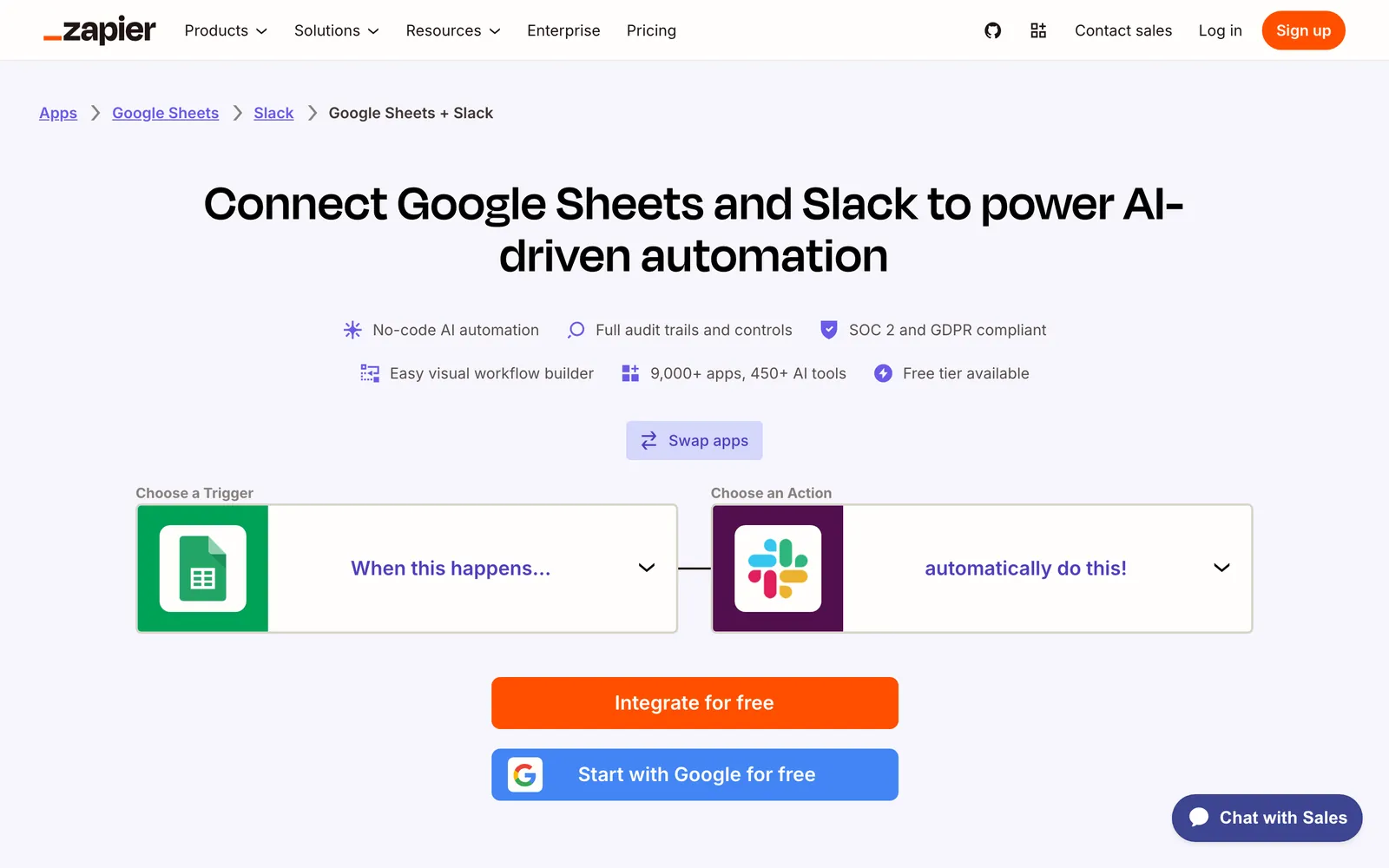
- the breadcrumb Apps > Google Sheets > Slack > Google Sheets + Slack
- 8 unique zap-template links
- trigger and action tabs, 6 blog post links and a 7-question FAQ
- links to 3 categories and to “similar apps” for each side
- footer link blocks
It has no body links to other Google Sheets + X pairs. upGrowth says template pages link back to both apps. Pairs also exist in both directions: Slack + Google Sheets has its own URL.
Where the graph is thin
Two gaps stand out. First, categories with 2,000+ apps rely on a “Load more” button. Google’s pagination guidance says its crawlers don’t click buttons. It recommends sequential <a href> pages, each with its own canonical. Whether apps 23 to 2,027 are reachable through plain links in the HTML hasn’t been verified. Second, a pair page reaches its siblings only through its parent app page. That works for popular pairs. A pair that isn’t in the parent’s top 30 has few paths in.

Why do some of Zapier’s integration combination pages get zero traffic?
Demand falls with each app you add. SALT.agency lists “slack integrations” at 1,400 searches, “trello slack” at 400 and “woocommerce slack trello” at 10. Ahrefs’ 2022 example shows the same drop. The Google Sheets page got about 1.9K visits from 444 keywords, and the Sheets + Trello + Slack page got none. In Ahrefs’ words: “the longer that ‘train’ gets, the fewer keywords the consequent ‘wagons’ rank for.”

Structure adds to the problem. Deeper pages sit further from the hub and get fewer internal links. That is my inference from the layout above, not something anyone measured.
Zapier seems to have drawn the same conclusion. The robots.txt lists no three-service sitemap. At the time of writing, /apps/google-sheets/integrations/slack--trello serves the /apps directory content, which suggests a redirect. The HTTP status wasn’t visible, so treat this as unconfirmed. SALT still described three tiers in February 2024.
How should hub pages be structured so thousands of programmatic pages each get link equity?
Use a tree instead of one hub that links to 5,000 pages. Zapier’s version is directory, then about 15 categories, then subcategories, then entity pages, then pairs. Each level has enough links to reach the next one, and none of them tries to list everything.
Google’s link guidance adds three rules:
- Google “can only crawl your link if it’s an
<a>HTML element.” - JS-inserted links are fine if they are real
<a href>elements. - “There’s no magical ideal number of links,” but if a page looks like it has too many, it probably does.
For listings longer than one screen, I’d ship paginated URLs like /category/crm?page=2 as plain links. Keep in mind that Zapier blocks /*? entirely. If you copy that rule, your pagination needs a path format such as /category/crm/page/2, or it won’t be crawled. More patterns are in the internal linking hub.
Which parts of Zapier’s approach can a smaller SaaS or directory copy, and which can’t it?
| Can copy | Can’t copy |
|---|---|
| URL hierarchy and text breadcrumbs | Data on 10,000+ partner apps, with triggers and actions |
| Pair pages linking to both parents | Partner-written copy (per Ahrefs, via a Ryan Berg study, unverified) |
| “Similar entity” cross-links | A domain with 6M backlinks (SALT) |
| Blocking parameter and landing variants in robots.txt | Branded demand from 25K+ “zapier …” keywords (Ahrefs) |
| One sitemap index per template | Partner placement programs (Silver+ benefits) |
| Publishing pairs selectively |

The right column is the hard part. Without unique data, a pair page is close to what Google’s spam policies call “Stitching or combining content… without adding value.” Zapier’s pages pass because each pair has real triggers, actions and templates. If yours only swap two names into a paragraph, the structure won’t save them. I covered what that looked like in 2026 in what Google’s updates removed.
How do you avoid orphan pages when generating every combination of two entities?
Don’t generate every combination. 10,400 apps allow about 54 million unordered pairs. By my arithmetic, 140,272 pair pages cover about 0.26% of them, and fewer than that once you account for A/B and B/A duplicates. Zapier publishes pairs where it has real integrations and templates.
For the pairs you do publish:
- Give every pair URL at least one
<a href>from its parent entity page, plus one from a sibling or related page. - Diff your sitemap against a crawl of your own site. Any URL in the sitemap with zero inbound links is an orphan.
- When you drop a tier, return 404 or 410 (or redirect), and remove it from the sitemap. Google’s crawl budget guide recommends 404/410 for removed pages and robots.txt, rather than noindex, for low-value variants.
Ahrefs’ current guide says to “remove or de-index pages that still earn nothing after a fair testing period.” Zapier’s apparent removal of its three-app pages fits that advice.
A link plan for a directory, marketplace or integration site
- Hub: links to every category and a short list of top entities. Nothing else.
- Categories (10 to 20): paginated with
<a href>and a self-canonical on each page. Link to subcategories and sibling categories. - Entity pages: link up to their categories, and down to the top pairs ranked by demand or usage.
- Pair pages: breadcrumbs, links to both entity pages and their categories, and “similar entity” links. Add the one thing Zapier skips: 5 to 10 sibling pairs that share an entity.
- Detail pages (templates, listings): link back to both parents.
- Crawl hygiene: one sitemap index per template, accurate lastmod, and parameter variants blocked.
- Pruning: pages with no traffic after a fair test get merged, removed or returned as 404/410.
Measure each template separately so you can see which level carries traffic. In Zapier’s case, the single-app pages beat the best pairs by 30 to 60 times in Practical Programmatic’s numbers. For more reference points, see these programmatic SEO benchmarks.